Ana Mercedes Hoyos is one of the few Latin American painters of the twentieth century whose practice moves with equal authority between rigorous abstraction and a deeply researched figurative language.
Across five decades of work — from her early Windows to her late bronze palenqueras — she built a coherent body of art that placed Afro-Colombian culture at the centre of modern Latin American painting. For an international audience approaching her work for the first time, Hoyos rewards close looking: there is more system, and more history, in each canvas than the bright palette first suggests.
Who is Ana Mercedes Hoyos
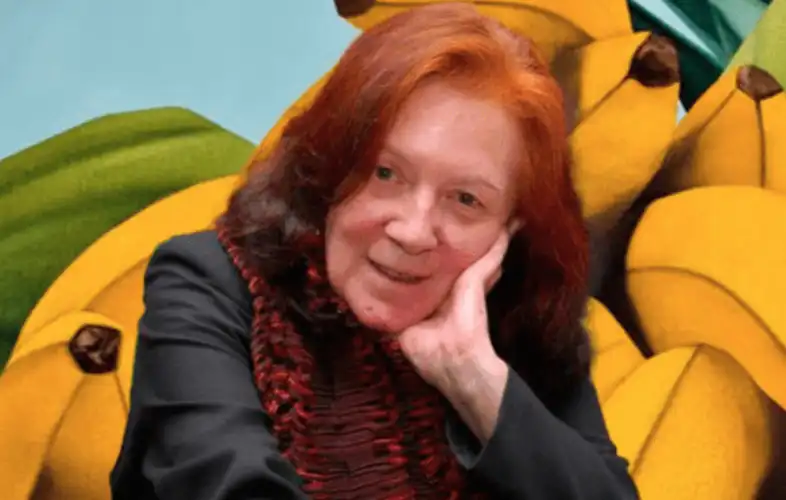
Ana Mercedes Hoyos Mejía was born in Bogotá on 29 September 1942 and died in the same city on 5 September 2014. She studied visual arts at the Universidad de los Andes under Juan Antonio Roda, Marta Traba and Armando Villegas, and took private painting lessons earlier with Luciano Jaramillo. She did not complete a formal degree, but the analytical rigour of that early training shaped a practice that always read painting as a problem of structure and light.
Her career took off in the late 1960s with works close to pop, before turning sharply towards abstraction in the 1970s and, from 1987 onwards, towards a figurative language built around still life and Afro-Colombian iconography. She received more than seventeen national and international awards and represented Colombia at the Paris Biennale (1977), the Tokyo Biennale (1979), the São Paulo Biennial and the Havana Biennial (1985).
Learn more about Ana Mercedes Hoyos biography
Ventanas: framing light at the start of a career
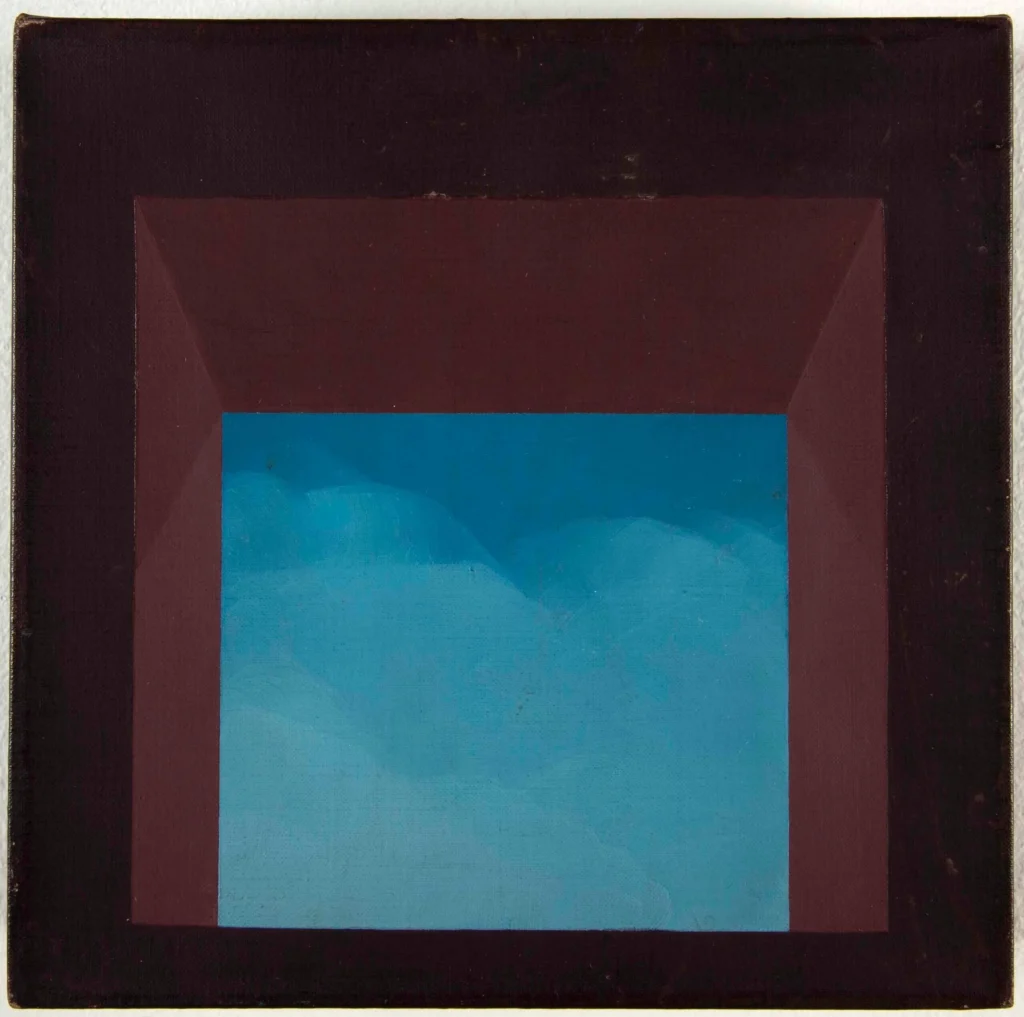
The Ventanas (Windows) series is the first fully resolved chapter of Hoyos’s art. Painted from the late 1960s onwards, these square oils use vertical and horizontal lines to enclose a passage of abstract landscape. The window is not a motif — it is a perceptual device. By isolating a fragment of the world, the painter slows down the act of looking and turns it into a study of colour transparency and light variation.
Windows positioned Hoyos within the discussion of geometric abstraction that defined a generation of Latin American painters in the 1960s and 1970s, but on her own terms. While many of her contemporaries pushed towards optical rigour, Hoyos kept a tactile, almost atmospheric quality in the brushwork. The series anticipates everything that follows: an abstraction that never abandons sensibility, and a figuration that never abandons structure.
Atmospheres: light released from the frame
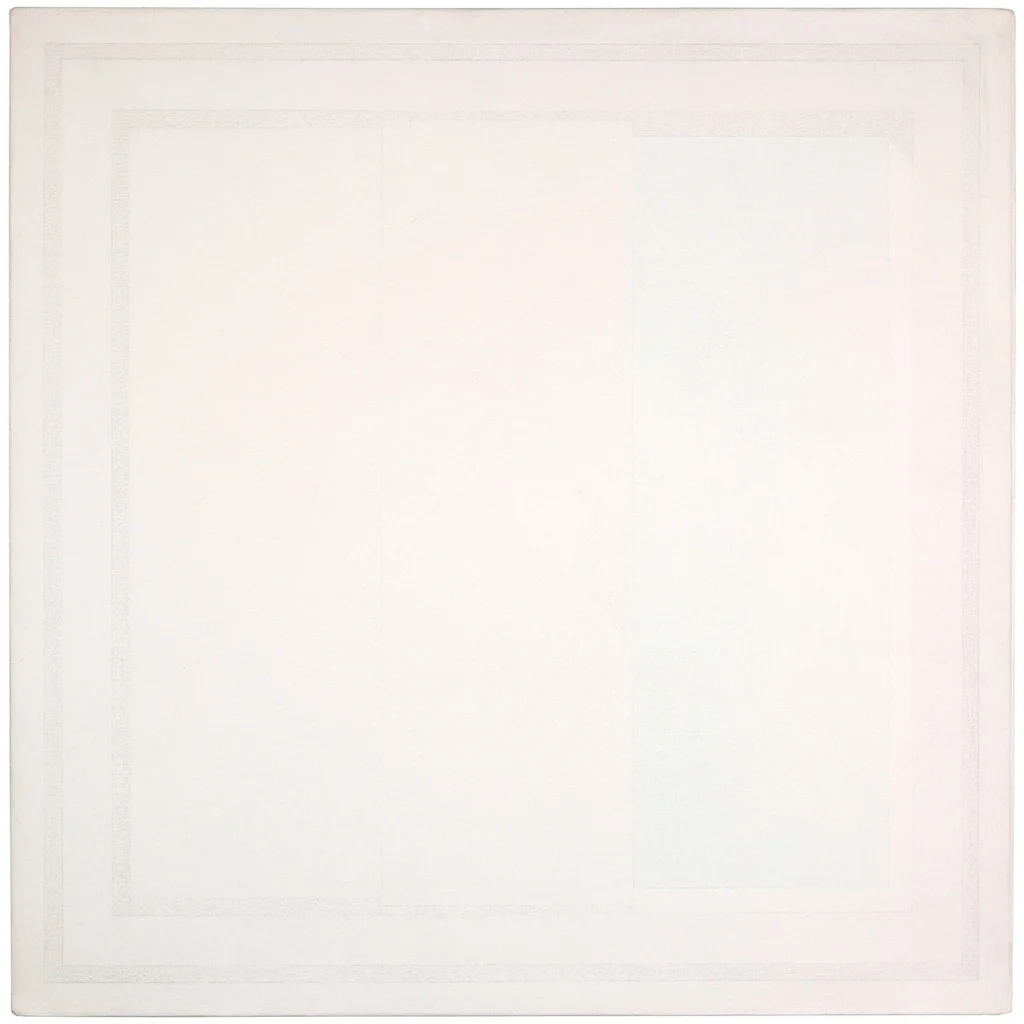
By the mid-1970s, Hoyos broke open the window. The Atmospheres series abandons the frame and pursues light as the central subject of painting. The canvases are dominated by very pale blues and whites, built up through alternating layers of colour modulated by a final white veil. Surfaces appear to breathe rather than to depict.
Atmospheres earned Hoyos the first prize at the XXVII National Salon of Visual Artists in 1978, a decisive moment in Colombian modern art that cemented her standing among her contemporaries. More importantly, the series clarified what her practice had been pursuing all along: a way to make colour and light behave like material, not like illusion.
Bodegones de Palenque: the Caribbean reframed as still life
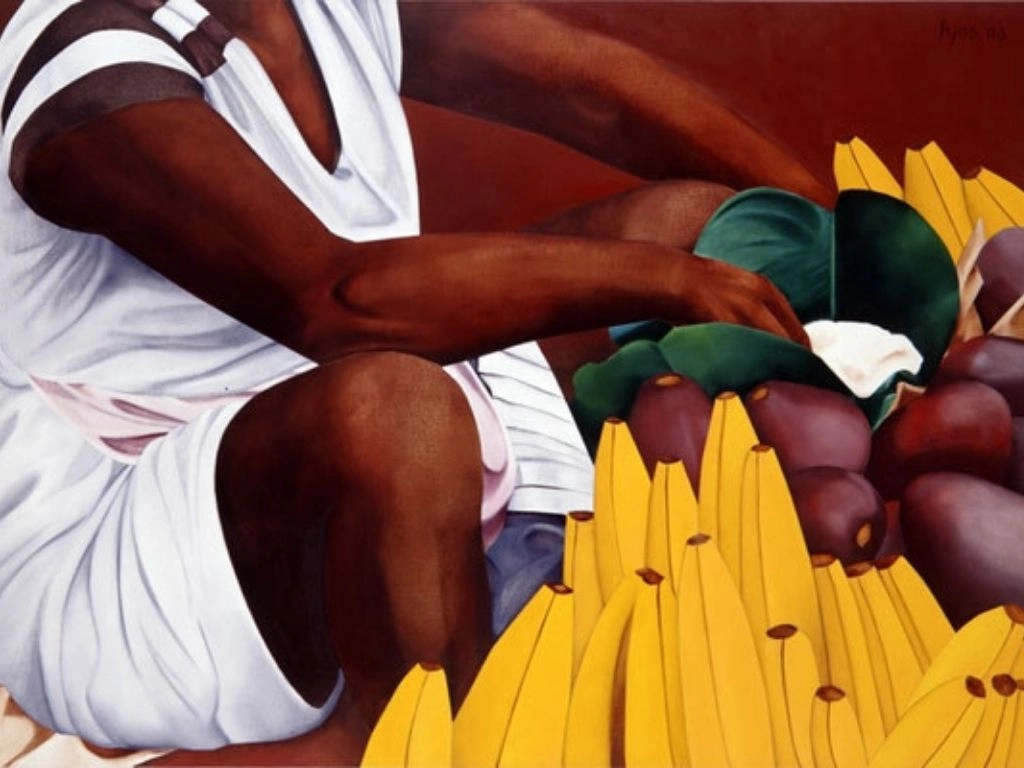
From 1987, Hoyos opened a new chapter in her art with the Bodegones de Palenque (Palenque still lifes). The series began in Cartagena, in front of the wooden trays — platones — that fruit vendors carry through the historic centre. Hoyos was researching the genealogy of cubism through European still life at the time, and she recognised in the intuitive cuts of tropical fruit the same formal logic that had triggered modern painting in Europe.
Her bodegones are not exercises in classical genre. They are investigations of colour as a cultural construction. The saturated palette and block-by-block organisation translate the Colombian Caribbean into a precise pictorial syntax, in dialogue with both geometric abstraction and the European still-life tradition. With this series, Hoyos turned a Western genre into a vehicle for thinking about identity, mestizaje and heritage.
Palenqueras: the iconography that defined her late practice
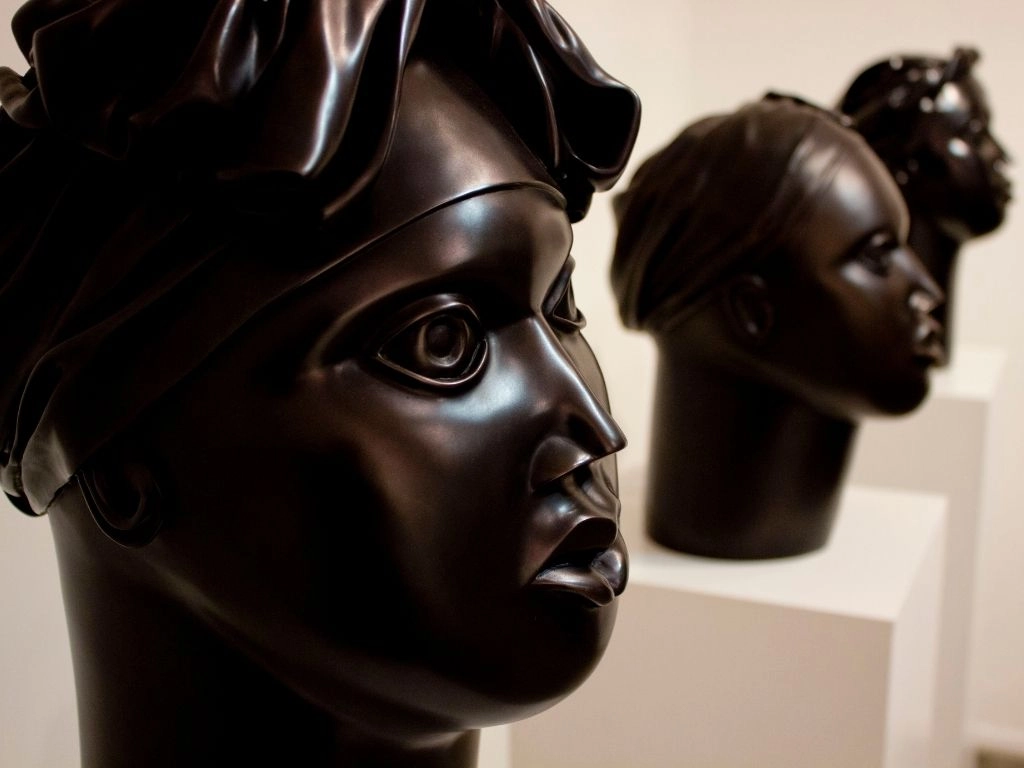
Through the bodegones, Hoyos arrived at the palenqueras. The figure of the Afro-descendant woman carrying a tray of fruit on her head — central to the culture of Colombia’s Caribbean coast and to San Basilio de Palenque, the first free town in the Americas — became the focus of her late production. Her friendship with Zenaida, the first palenquera she painted, anchored a sustained investigation into the dignity, strength and history of maroon communities.
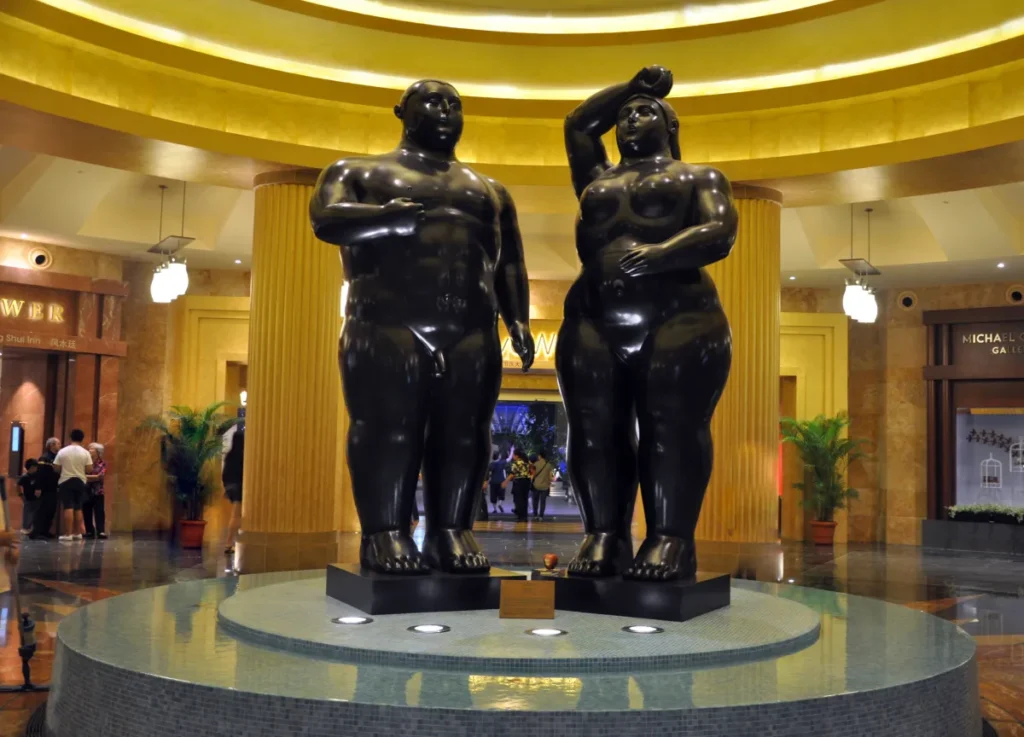
The palenqueras and the related A Rhythm of Palenque publication articulate an Afro-Colombian iconography that escapes folklorism. In her final years, Hoyos extended this research into sculpture: large-scale bronze pieces in which trays, fruit and figures gain monumentality. The shift from canvas to bronze confirmed the patrimonial weight of the series.
Key Ana Mercedes Hoyos artworks
Critical and curatorial readings of Ana Mercedes Hoyos’s artwork tend to converge around the following pieces and series:
- Ventanas (from the late 1960s). Founding series. Establishes Hoyos’s geometric abstraction and her sensitivity to light.
- Atmospheres (mid-1970s). The body of work that won the XXVII National Salon of Visual Artists in 1978.
- Bodegones de Palenque (from 1987). Figurative series that articulates still-life tradition with Caribbean culture.
- Lazos. Paintings devoted to the processions of San Basilio de Palenque.
- Palenqueras. The most internationally recognised cycle of her work, foundational to her Afro-Colombian iconography.
- Large-format bronzes (late period). Sculptural translations of the palenquera figure and its everyday objects.
These works form the core of every serious retrospective of the artist and remain the strongest reference for both museum programming and private collecting.
Museum presence and auction record
Ana Mercedes Hoyos’s artwork is held in institutional collections including the Museum of Modern Art of Bogotá (MAMBO), the Banco de la República in Colombia, the Solomon R. Guggenheim Museum in New York and the Jorge M. Pérez Collection in Miami. In 2024, MAMBO devoted a retrospective to her work — Through the Window: Ana Mercedes Hoyos. A Retrospective — bringing together more than one hundred pieces that traced the path from her abstract beginnings to her late still lifes. It was her fourth solo exhibition at the museum.
Public auction records offer a clear picture of her international standing. Most of her works at Christie’s and Sotheby’s have realised hammer prices between US$25,000 and US$50,000, with the current record set by Mural in Three Parts, sold at Sotheby’s New York in 2014 for US$245,000. Her sustained institutional presence and the gradual rise in her auction valuations place her among the names to follow within the wider conversation on women shaping Latin American art.
Ana Mercedes Hoyos art at Duque Arango Gallery
Ana Mercedes Hoyos art is part of the secondary market programme at Duque Arango Gallery. Windows, Atmospheres, Bodegones de Palenque, palenqueras and bronze sculptures are presented to collectors through a private advisory process in which provenance, curatorial context and availability are reviewed case by case. To access the current selection of Ana Mercedes Hoyos artwork, please request to be contacted by the gallery.