In recent years, the international art market has witnessed a renewed and sustained interest in fiber art, particularly in works that blur the boundaries between craft, sculpture, and abstraction. At the center of this movement stands Olga de Amaral, one of the most influential figures in contemporary textile art.
For collectors in the United States and globally, her work represents historical relevance, institutional validation, and a growing market trajectory. With major retrospectives at institutions such as the Museum of Fine Arts Houston in 2021 and the Fondation Cartier pour l’art contemporain in 2024–2025, her international presence has been reaffirmed at the highest level.
This guide provides collectors with a comprehensive understanding of her artistic significance, materials, exhibitions, and market performance, while addressing the most frequently searched questions about her work, fiber art, and women artists in contemporary art history.
Who is Olga de Amaral?
Olga de Amaral was born in Bogotá in 1932 and trained initially in architectural design before studying textiles at the Cranbrook Academy of Art in the United States. Her education placed her in direct dialogue with Bauhaus-inspired design principles through the influential textile designer Marianne Strengell, shaping her early understanding of structure, material, and abstraction.
Upon returning to Colombia in 1955, she established a textile workshop and contributed to the development of formal textile education at the Universidad de los Andes, helping institutionalize fiber art as an academic discipline in Latin America.
By the late 1960s, her work entered the international art circuit through exhibitions such as:
- Wall Hangings (1969) at the Museum of Modern Art
- Women’s Woven Walls (1970) at the Museum of Arts and Design
- Participation in the Venice Biennale
Today, her work is held in major museum collections, including the Tate Modern and the Art Institute of Chicago, confirming her long-term institutional relevance.
What Is Olga de Amaral Known For? Monumental Textile Sculpture and Material Innovation
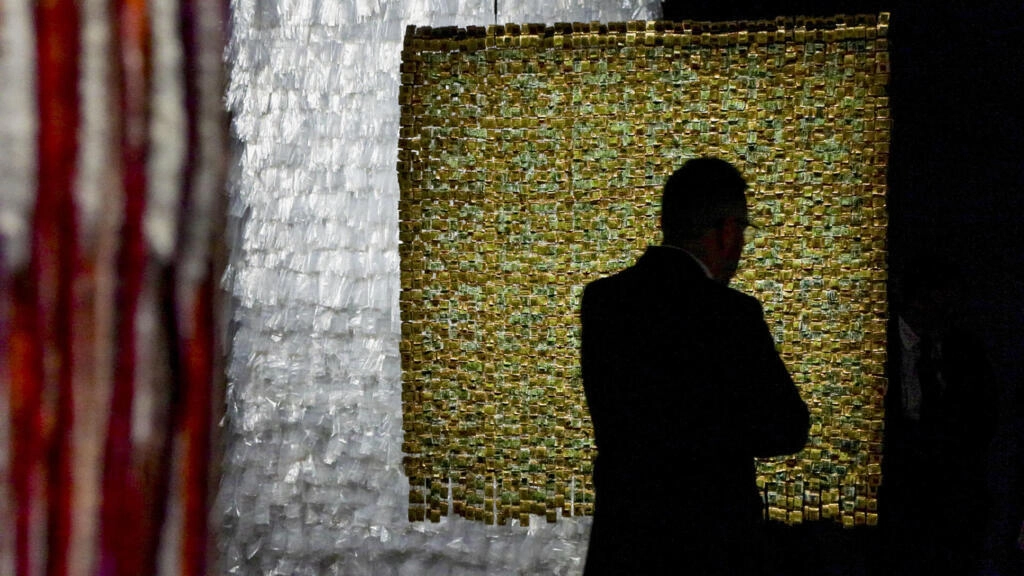
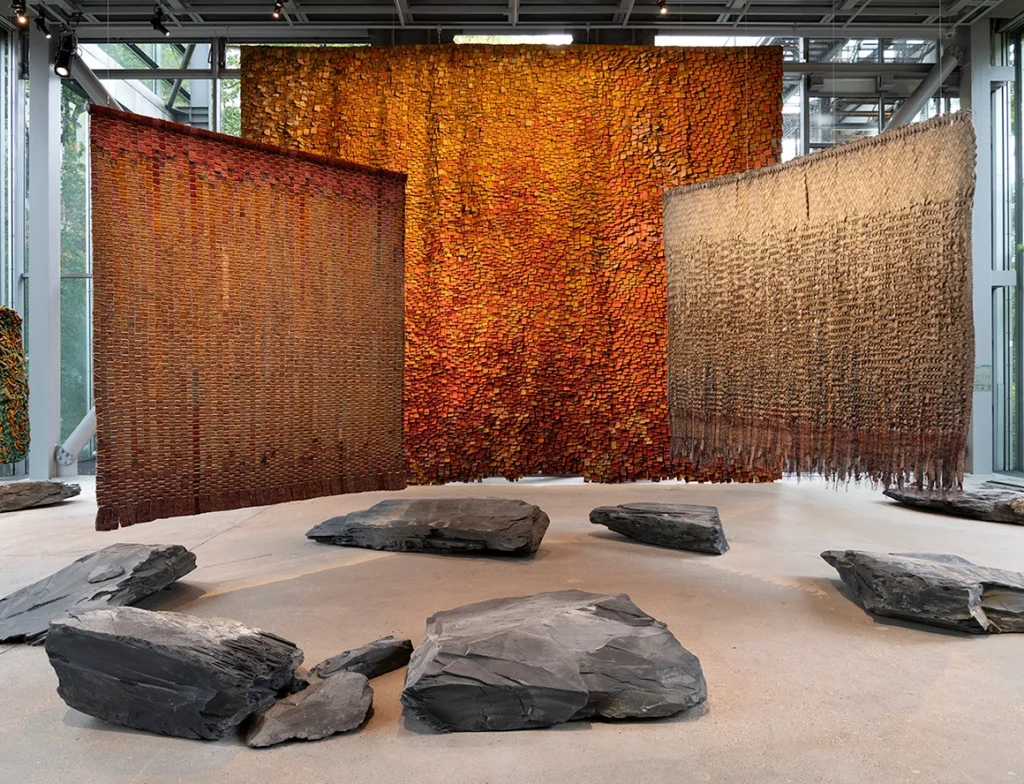
Olga de Amaral is internationally recognized for transforming traditional weaving into large-scale sculptural environments. Her works are neither paintings nor tapestries in the conventional sense; they are spatial structures that interact with light, architecture, and movement.
Her reputation rests on three defining characteristics:
- Architectural Scale: Many of her works are monumental installations designed to occupy space rather than decorate walls.
- Material Transformation: She elevates humble materials such a linen, cotton, wool, etc. into sculptural compositions with tactile and visual depth.
- Conceptual Symbolism: Her works often evoke landscapes, sacred objects, and cosmological references, connecting contemporary abstraction with pre-Columbian visual traditions.
Why Does Olga de Amaral Use Gold Leaf?
Material, Symbolism, and Cultural Memory
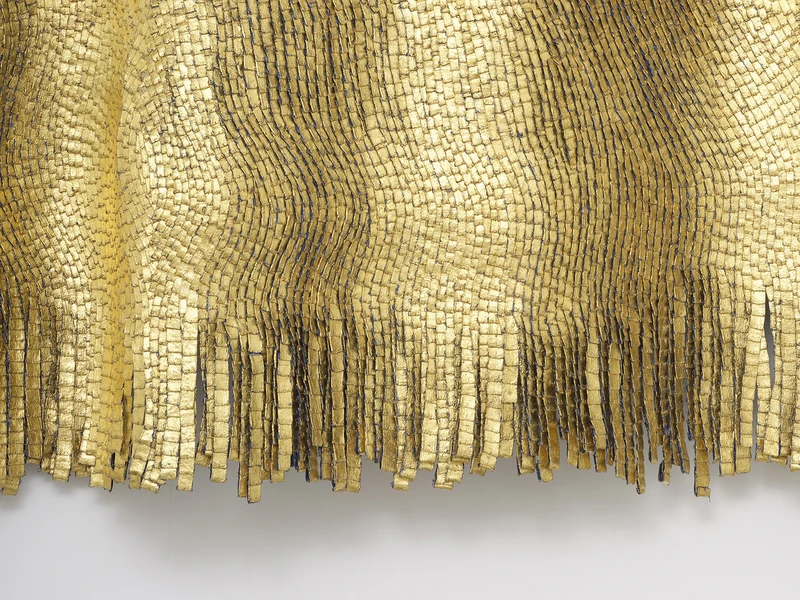
The use of gold leaf in Olga de Amaral’s practice is both technical and symbolic.
Material Function
Gold leaf adds:
- Reflectivity
- Structural emphasis
- Surface durability
- Visual luminosity
Unlike paint, gold leaf interacts dynamically with light, producing subtle shifts in tone depending on the viewer’s position.
Symbolic Meaning
Gold in her work references:
- The sun as a life-giving force
- Pre-Columbian metallurgy traditions
- Colonial histories of extraction and power
- Spiritual transformation
This symbolism is particularly evident in her Alquimia and Estelas series, where gold surfaces evoke ancient monuments and sacred relics.
Is Olga de Amaral Considered a Fiber Art Pioneer?
Yes, Olga de Amaral is widely recognized as one of the pioneers of fiber art in Latin America and a key contributor to the global movement that redefined textiles as fine art.
During the 1960s and 1970s, artists began challenging the hierarchy that separated craft from high art. Amaral’s work played a decisive role in this transformation.
Her innovations include:
- Moving textiles off the wall into three-dimensional space
- Combining weaving with sculpture and installation
- Expanding the scale of textile production
- Introducing non-traditional materials into weaving
Institutions have formally acknowledged this impact. She received the Guggenheim Fellowship in 1973 and the Visionary Artist Award from the Museum of Arts and Design in 2005, recognizing her influence on contemporary art practices.
Today, her legacy extends beyond aesthetics. She helped redefine the cultural and economic value of textile-based art.
What Is Olga de Amaral’s Artistic Style? From Geometry to Spiritual Abstraction
Olga de Amaral’s artistic style evolved over decades, reflecting both formal experimentation and philosophical inquiry.
Early Period: Modernist Geometry
Her early works show strong influence from Bauhaus design principles:
- Grid structures
- Repetition
- Functional clarity
- Neutral color palettes
These works emphasized order, balance, and architectural logic.
Mature Period: Organic and Monumental Forms
Over time, her compositions became:
- Larger
- More tactile
- More sculptural
- More symbolic
Series such as Brumas, Estelas, and Alquimia introduced movement, irregular textures, and luminous surfaces.
This evolution reflects a shift from strict modernism toward expressive abstraction rooted in nature and spirituality.
What Materials and Techniques Does Olga de Amaral Use?
Olga de Amaral works with a wide range of traditional textile materials, including wool, linen, cotton, silk, and horsehair, which form the organic foundation of her artistic language. She complements these fibers with structural materials such as gesso, acrylic paint, and metallic leaf (typically gold) that add strength, texture, and a distinctive luminous quality to the surface.
In terms of process, she employs a broad spectrum of textile techniques, including weaving, knotting, braiding, layering, and surface coating. The integration of these materials and methods allows her to create works that move beyond the conventional definition of tapestry, functioning simultaneously as textiles and as sculptural forms.
What Happened at the Fondation Cartier Exhibition with Olga de Amaral?
The 2024–2025 retrospective at the Fondation Cartier pour l’art contemporain marked a historic moment in Olga de Amaral’s career.
It was her first major retrospective in Europe, one of the largest exhibitions of her work ever organized and a critical milestone in the global recognition of Latin American fiber art
The exhibition presented approximately 80 works spanning six decades of production, including monumental installations from the Brumas series.
Curatorially, the exhibition emphasized three themes: Material transformation, spiritual symbolism and architectural space
How Much Are Olga de Amaral’s Works Worth? Market Trends and Price Ranges
The market for Olga de Amaral has shown sustained growth over the past decade, particularly following major museum exhibitions.
Record Auction Results
Recent sales demonstrate a clear upward trajectory:
- Imagen perdida 27 (1996) — $1.17 million (Phillips, New York, 2025)
- Pueblo X (2013) — $698,500 (Sotheby’s, 2024)
- Cesta Lunar 50a (2013) — $555,000 (Sotheby’s, 2018)
These figures place her among the most valuable Latin American women artists working in textile media.
Key value drivers include:
- Scale
- Use of gold leaf
- Exhibition history
- Provenance
- Condition
Importantly, while market indicators can suggest growth, no artwork can be guaranteed to increase in value. The art market is influenced by institutional recognition, collector demand, and broader economic conditions.
What Museum Exhibitions Has Olga de Amaral Had? Institutional Recognition and Cultural Authority
Museum exhibitions are among the most reliable indicators of an artist’s historical significance and market stability.
Olga de Amaral’s exhibition history includes:
- 1969, Wall Hangings — Museum of Modern Art, New York
- 1970, Women’s Woven Walls — Museum of Arts and Design, New York
- 1986, Venice Biennale
- 2021, To Weave a Rock — Museum of Fine Arts Houston
- 2024–2025, Major retrospective — Fondation Cartier, Paris
- 2025, Exhibition — Institute of Contemporary Art, Miami
- 2026, Major retrospective — Museo de Arte Latinoamericano de Buenos Aires
This sustained institutional presence over more than five decades is one of the strongest indicators of long-term artistic relevance.
Why Is Olga de Amaral Important in the History of Women Artists?
Olga de Amaral’s career reflects broader changes in how women artists are recognized in the global art system. Historically, textile work was often categorized as craft rather than fine art, limiting recognition for female artists working in fiber. Her work challenged that distinction. By integrating weaving into sculpture, architecture, and installation, she helped redefine textiles as a central medium in contemporary art.
Today, the rise of exhibitions focused on women artists and the increasing demand for historically overlooked voices have contributed to renewed interest in her work.
Collecting Olga de Amaral: What Serious Collectors Should Consider
For collectors evaluating her work, several factors are essential.
Authentication: Every legitimate work should include:
- Signature and date
- Title and identification label
- Certificate of authenticity from Casa Amaral
Conservation: Textile works require specific environmental conditions.
Recommended guidelines include:
- Temperature around 20°C; relative humidity 50–55%; lighting, low-intensity, UV-filtered
- Proper conservation not only protects the artwork but also preserves its long-term market value.
The Long-Term Outlook for Olga de Amaral in the Global Art Market
Olga de Amaral occupies a rare position in contemporary art history.
She combines institutional recognition, historical significance, material innovation and market momentum
Few artists achieve sustained relevance across decades while continuing to influence new generations of artists and collectors.