
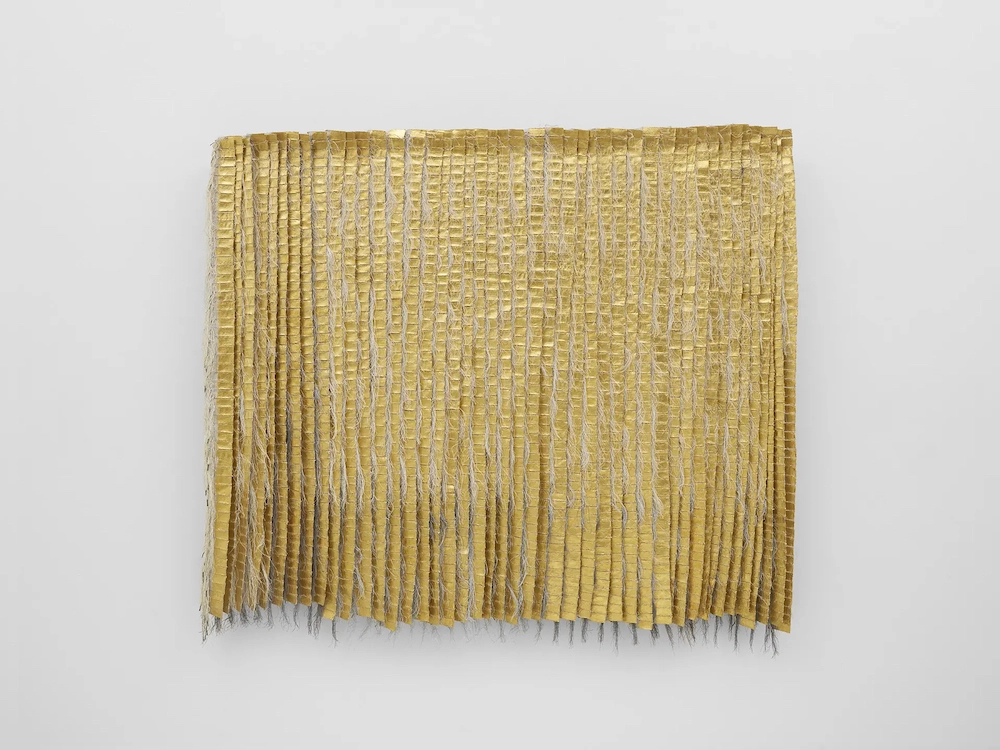
The current Olga de Amaral exhibition at MALBA marks a decisive institutional moment for one of the most influential figures in postwar Latin American abstraction. For an audience already familiar with the trajectory of the artist Olga de Amaral, this presentation offers not only a renewed art historical framing, but also a deeper understanding of her technical rigor, conceptual evolution, and enduring relevance within the global field of fiber-based practices.
Her presence at the Museo de Arte Latinoamericano de Buenos Aires (MALBA) consolidates decades of international recognition that have included major institutional platforms such as the Fondation Cartier pour l’art contemporain and the Institute of Contemporary Art, Miami. The exhibition situates her within a transnational narrative that moves beyond the categorization of “fiber art” to address her practice as a radical redefinition of material and surface.
Understanding Olga de Amaral: What is Olga de Amaral known for?
To understand the scope of the current Olga de Amaral exhibition, one must revisit her formative years at the Cranbrook Academy of Art in Michigan during the 1950s. Cranbrook’s emphasis on weaving as both craft and experimental discipline profoundly shaped her early practice. Yet even at this stage, her approach diverged from traditional textile design: she treated the loom not as a tool for utility but as a vehicle for spatial inquiry.
Upon returning to Bogotá, she co-founded the textile department at the Universidad de los Andes, embedding modernist rigor into Colombia’s artistic pedagogy. From the outset, her Olga de Amaral technique integrated pre-Columbian references, architectural thinking, and modern abstraction, placing her in dialogue with contemporaries while asserting a distinctly Latin American vocabulary.
Olga de Amaral MALBA exhibition
The MALBA presentation highlights the transformation from early woven structures to the monumental, gold-infused works that redefined her international reputation. Series such as Estelas and Brumas are present showing Olga de Amaral’s shift toward layered constructions that dissolve the boundaries between painting and sculpture.
In Estelas, suspended columns of woven and gilded material evoke both funerary stelae and vertical landscapes. The incorporation of gold leaf, which has become synonymous with Olga de Amaral gold works, is neither ornamental nor symbolic in a literal sense. Instead, gold operates as a metaphysical and optical agent, catching and dispersing light across irregular surfaces.
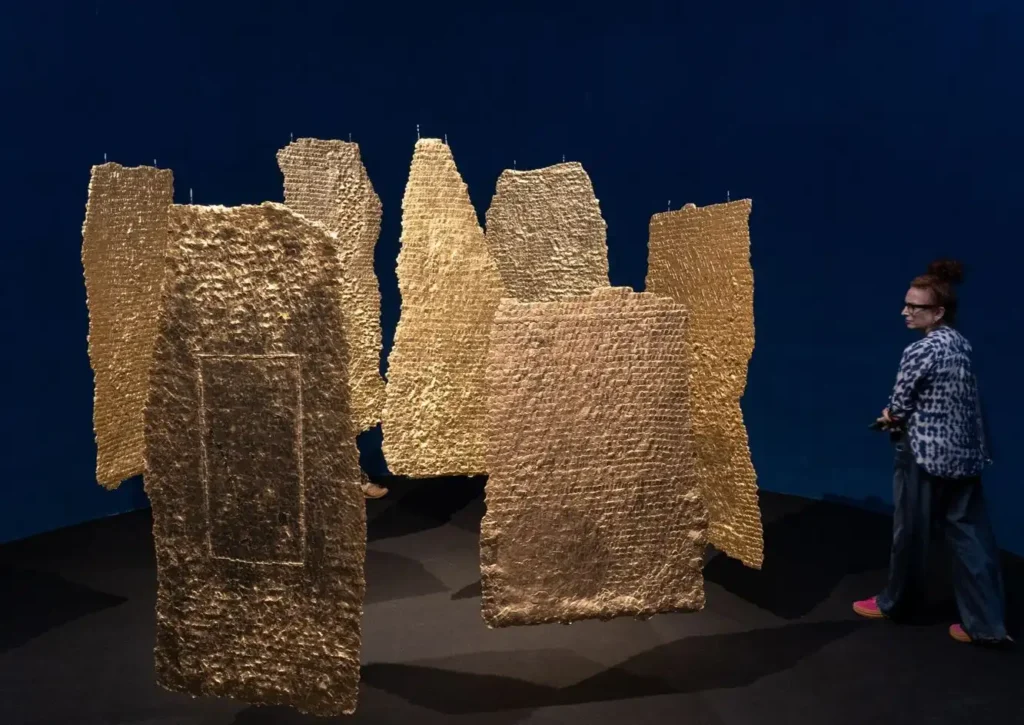
The Brumas Olga de Amaral series, represented in the exhibition, further intensifies her investigation into atmosphere and dematerialization. These works appear almost immaterial from a distance, yet upon close inspection reveal complex accumulations of gesso, pigment, and metal leaf over woven structures.
Olga de Amaral exhibitions around the world: Where to see Olga de Amaral artworks
The current Olga de Amaral exhibition at MALBA must be contextualized within the broader arc of recent institutional validation. The landmark retrospective at the Fondation Cartier pour l’art contemporain, repositioned Olga de Amaral oeuvre within European modernism and contemporary discourse. That exhibition assembled more than eight decades of production and confirmed her standing as a central figure in global abstraction.
Similarly, the presentation at the Institute of Contemporary Art, Miami (ICA Miami Olga de Amaral) emphasized the architectural dimension of her installations, situating them within Miami’s dialogue on Latin American diasporic art histories.
Her work is also held in major museum collections, including the Museum of Fine Arts, Houston (MFAH), underscoring the sustained institutional interest that extends far beyond temporary exhibitions.
Olga de Amaral Technique: Weaving as Structural Thought
For those art lovers seeking deeper insight into Olga de Amaral artwork, the technical complexity of her process remains central. Olga de Amaral’s artworks are not simply woven textiles; they are constructed through successive interventions. After weaving cotton, linen, or horsehair structures, she often applies layers of gesso, acrylic, and gold or silver leaf. In certain series, threads are bound, knotted, or left to hang freely, creating volumetric surfaces that oscillate between relief and free-standing object.
This hybridization complicates traditional categories of fiber art. Indeed, while she is often associated with the fiber movement, her practice exceeds it conceptually and materially. The MALBA exhibition underscores this by emphasizing spatial installation rather than flat display, reinforcing her position within sculptural discourse.
Market Context and Collecting
The market for Olga de Amaral for sale has expanded significantly over the past decade. Major international auction houses have recorded strong results, particularly for monumental gold-leaf works from the 1980s and 1990s. The increasing global demand reflects both institutional validation and a broader reevaluation of textile-based abstraction.
Importantly, the MALBA exhibition contributes to market stability by reinforcing scholarship and provenance. Museum exhibitions remain a primary driver of confidence for serious collectors, particularly in the secondary art market.
Where is Olga de Amaral from?
Although frequently associated with Paris or Miami, her intellectual and cultural foundation remains deeply tied to Bogotá. The synthesis of Andean light, pre-Columbian textile traditions, and European modernist training defines her visual language.
The MALBA Exhibition: Curatorial Significance
At MALBA, the exhibition is a curatorial argument, it positions Olga de Amaral as a central architect of Latin American modernism whose practice anticipates contemporary discourses around materiality, gender, and decolonial aesthetics.
The installation emphasizes scale and light, allowing viewers to perceive how gold surfaces respond dynamically to architectural context. This approach aligns with the spatial strategies seen in prior presentations at institutions like the Fondation Cartier pour l’art contemporain, yet the Buenos Aires context introduces a distinct regional resonance.
For an expert audience, the exhibition provides a rare opportunity to reassess canonical series such as Brumas and Estelas within a Latin American museum framework rather than through a Euro-American lens.
The resurgence of interest in material-driven abstraction has placed Olga de Amaral art at the forefront of contemporary discourse. As institutions worldwide expand narratives around women artists and textile practices, her work emerges not as a rediscovery but as a long-overdue acknowledgment.
The MALBA exhibition consolidates her status within the canon while reinforcing the international visibility previously amplified by the Fondation Cartier pour l’art contemporain and the Institute of Contemporary Art, Miami.
For collectors, scholars, and curators, this moment represents more than an exhibition cycle; it signals the stabilization of her position within art history and the global market. The sustained attention to Olga de Amaral artwork, from Bogotá to Paris to Miami and now Buenos Aires, confirms that her practice transcends geography, medium, and categorization.
As galleries and institutions continue to build scholarship around her oeuvre, exhibitions of this caliber serve not only as cultural milestones but also as anchors of trust. In a market increasingly attentive to rigor, provenance, and institutional endorsement, the MALBA presentation reinforces Olga de Amaral’s place among the defining artists of the twentieth and twenty-first centuries.