A Foundational Figure in Contemporary Fiber Art
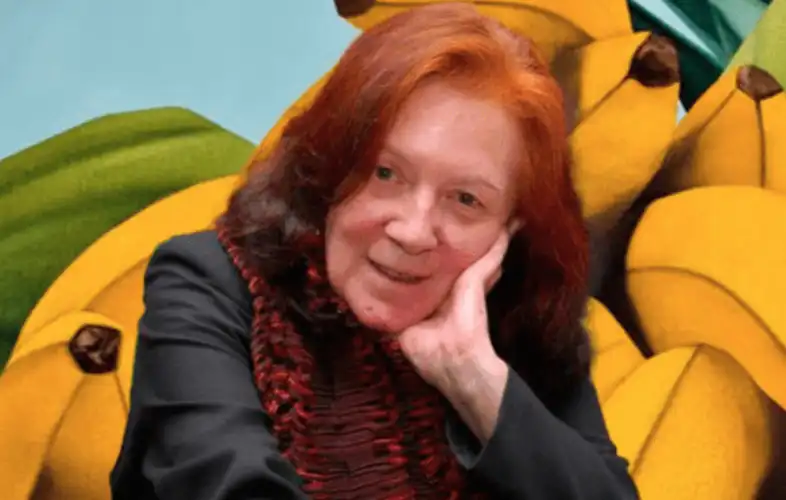
For those familiar with the history of modern Latin American abstraction, the name Olga de Amaral is not peripheral but structural: she stands at the intersection of material experimentation, spiritual abstraction, and architectural scale. Olga de Amaral is widely recognized as one of the most influential figures in postwar textile art and a central protagonist in the expansion of fiber into the realm of contemporary art.
Educated at the Cranbrook Academy of Art in Michigan, where she studied fiber art in the mid-1950s, Olga de Amaral absorbed both Bauhaus-derived design principles and pre-Columbian textile traditions. The impact of Cranbrook on the development of the artist Olga de Amaral cannot be overstated: the emphasis on structure, loom-based experimentation, and material autonomy became foundational to her later explorations. Yet her work cannot be reduced to North American modernism. Instead, it evolved into a singular synthesis of Andean textile memory, gold’s symbolic weight in pre-Hispanic cultures, and post-minimalist sensibility.
Today, discussions around Olga de Amaral fiber art invariably acknowledge her role in dismantling the boundary between craft and high art.
Material Radicality: Weaving, Gold Leaf and Alchemical Surfaces
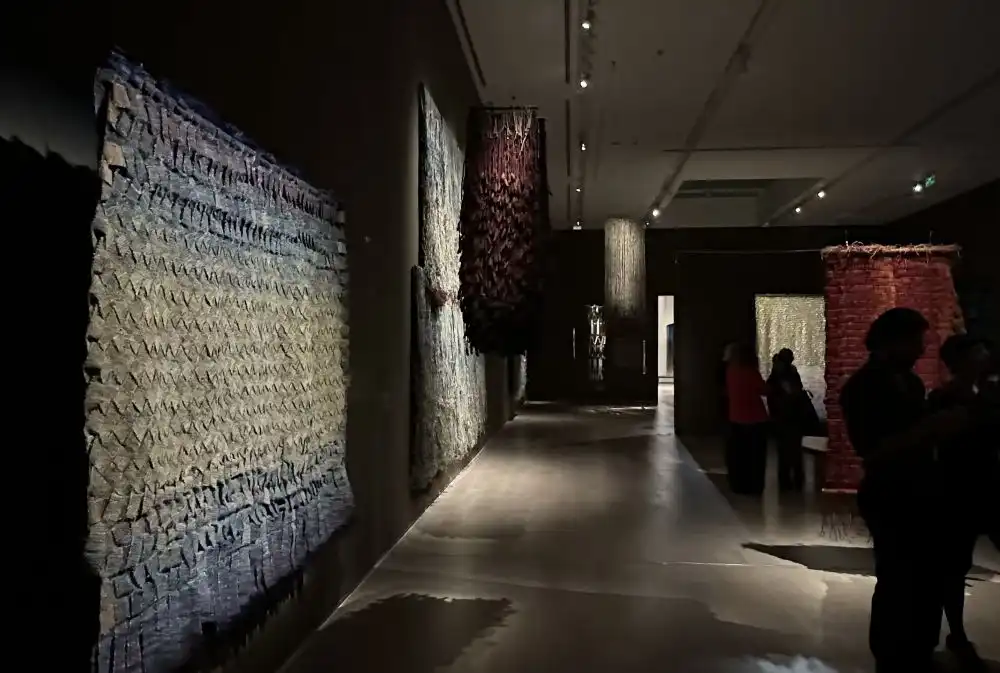
The most celebrated body of Olga de Amaral art revolves around her integration of gold leaf into woven and constructed surfaces. Beginning in the 1970s, she developed a meticulous process: linen or cotton fibers are woven, treated with gesso, layered with gold or silver leaf, and sometimes partially burnished or cracked. The resulting surfaces oscillate between textile and sculpture, painting and object.
Her series such as Estelas, Brumas, and Alquimias embody this hybrid condition:
Olga de Amaral gold works are neither decorative nor symbolic in a literal sense, they function as luminous fields that activate space architecturally.
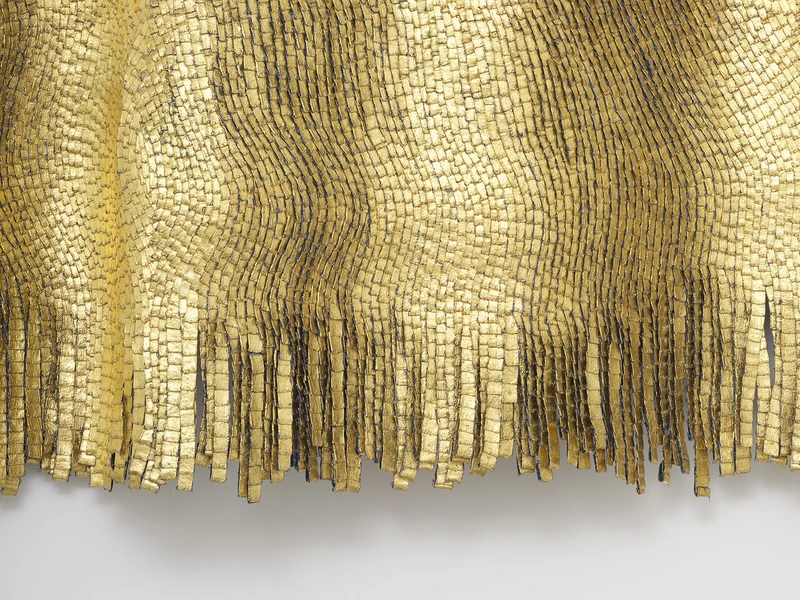
In the Brumas Olga de Amaral series, gold dissolves into atmospheric gradations, suggesting landscapes without representation.

In Olga de Amaral Estelas, vertical modular elements recall both pre-Columbian stelae and modernist relief.
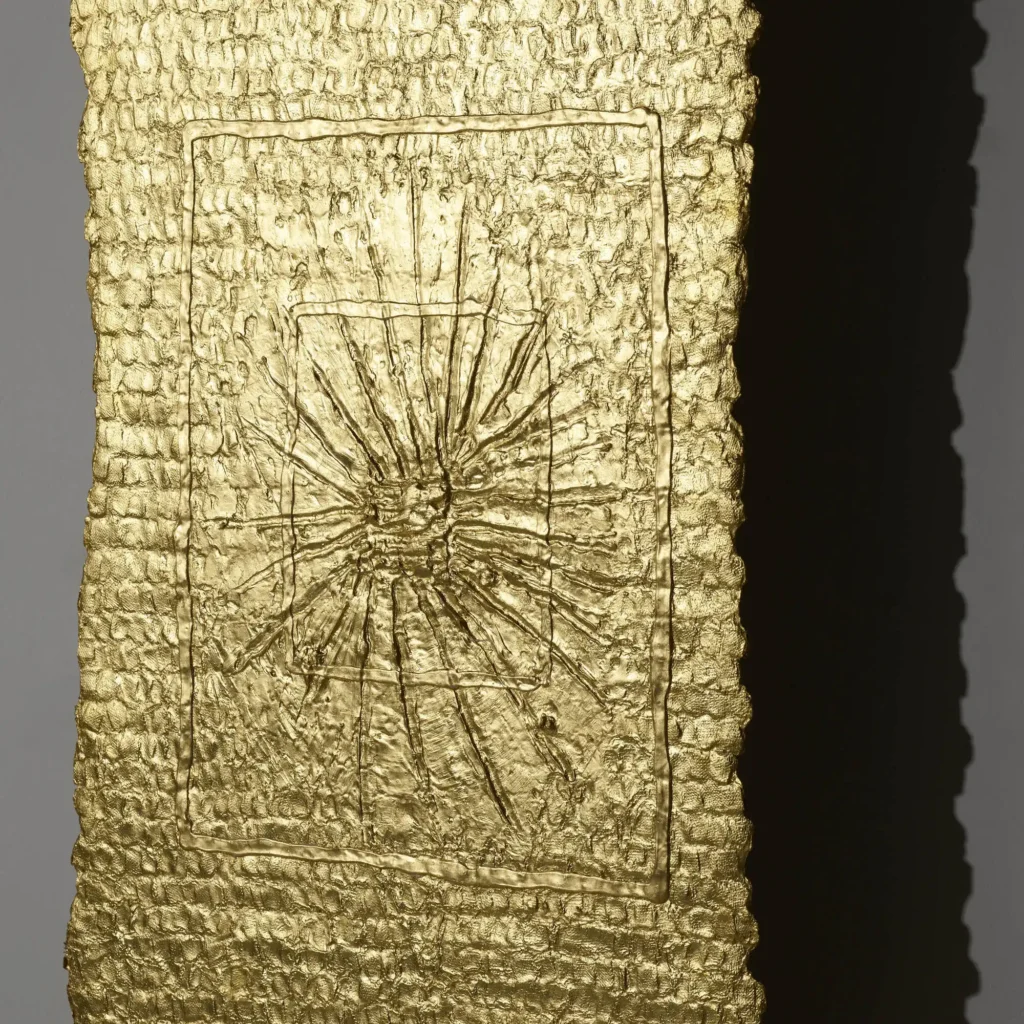
The process behind Olga de Amaral technique is central to her market and institutional valuation. Unlike industrial minimalism, her works are labor-intensive and materially complex. Each piece is a convergence of loom structure, hand intervention, and surface alchemy. For advanced collectors, understanding this technical rigor is essential when evaluating Olga de Amaral artwork in secondary markets.
Olga de Amaral Institutional Recognition: From Fondation Cartier to ICA Miami
Olga de Amaral’s international legacy has been firmly consolidated through major museum exhibitions. Her landmark retrospective at the Fondation Cartier pour l’art contemporain significantly elevated her global visibility. This Parisian exhibition positioned her as a global contemporary artist whose work dialogues with architecture, spirituality, and abstraction at a global scale.
In the United States, presentations connected to the Institute of Contemporary Art Miami strengthened her profile in North America, generating significant attention. The presence of her work in Miami is particularly relevant within the context of Latin American collectors and the transnational art market ecosystem anchored in South Florida.
Her work is also held in major museum collections, including the Museum of Fine Arts, Houston, MoMA, and others.
Market Evolution: Auctions, Galleries and Price Structure
In recent years, interest in Olga de Amaral auction results has increased significantly, reflecting a broader institutional reevaluation of textile-based practices. As the market corrects decades of under-recognition of fiber art and art made by women, her prices have demonstrated steady growth, particularly for gold-leaf works from the 1970s and 1980s.
Olga de Amaral prices behavior frequently reflects collectors’ interest in understanding value segmentation: early woven wall reliefs, modular gold panels, and large-scale installations occupy different tiers.
Olga de Amaral biography: Who is Olga de Amaral?
Born in Bogotá in 1932, Olga de Amaral belongs to a generation of Latin American artists who negotiated modernism through localized cultural memory. Her engagement with Andean textile traditions was not folkloric but structural.
In Michigan. At Cranbrook, she encountered a modernist pedagogy that emphasized weaving as architecture, an idea she would later expand monumentally.
Yet her practice remains conceptually contemporary, evidenced by renewed curatorial attention and collaborations that have extended into design and fashion dialogues, including references to her collaboration with the couture house Christian Dior to create the Olga de Amaral Lady Dior bag, where her aesthetic vocabulary intersects with fashion.
Despite her international circulation, Bogotá, her hometown, remains central to her identity. Her studio practice in Colombia has anchored her work geographically, even as her exhibitions move between Paris, Miami, Houston, and beyond.
Legacy and Strategic Acquisition
Olga de Amaral’s international market legacy is not speculative; it is structurally supported by museum retrospectives, blue-chip representation, and a recalibrated understanding of fiber within contemporary art history. The renewed attention to Olga de Amaral indicates sustained curatorial momentum rather than temporary trend.
For collectors operating at a sophisticated level, acquisition decisions around Olga de Amaral should consider series, exhibition history, scale, and condition, as well as alignment with broader holdings in Latin American abstraction or material-driven contemporary practices.
As global discourse continues to reassess medium hierarchies and as gold reemerges conceptually in contemporary practice, the position of the artist Olga de Amaral appears not only secure but increasingly central. Her work occupies a rare position: historically grounded, materially radical, spiritually resonant, and institutionally validated.
Within this context, access to museum-quality works with verified provenance becomes a matter of both connoisseurship and timing. For collectors seeking to engage with Olga de Amaral artwork at a serious level, working with galleries deeply embedded in the Latin American modern and contemporary ecosystem ensures both scholarly rigor and market confidence.