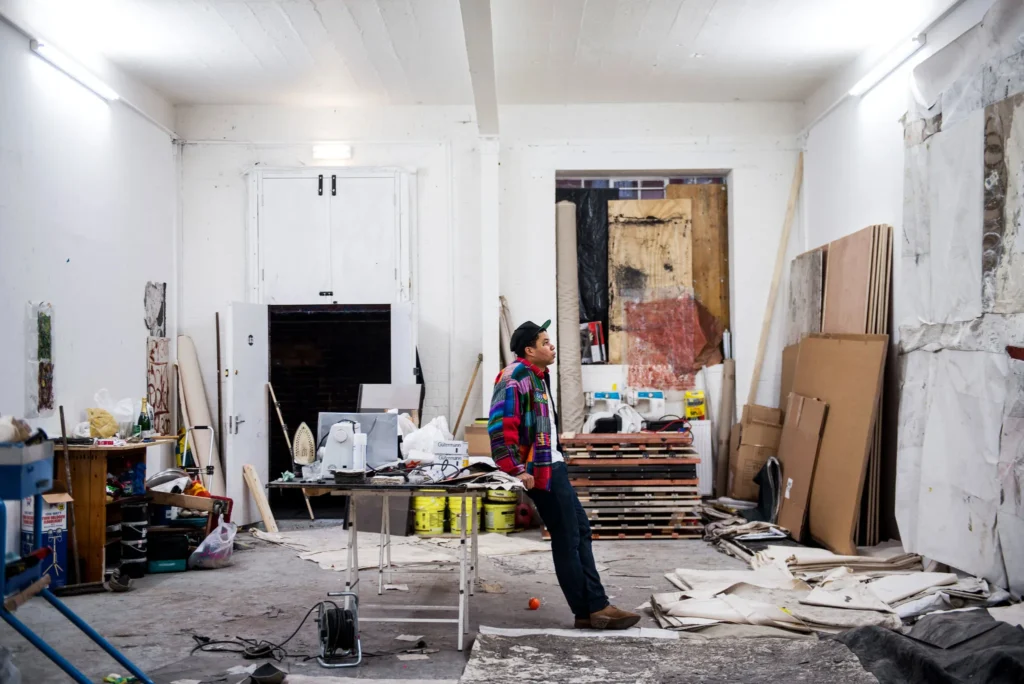
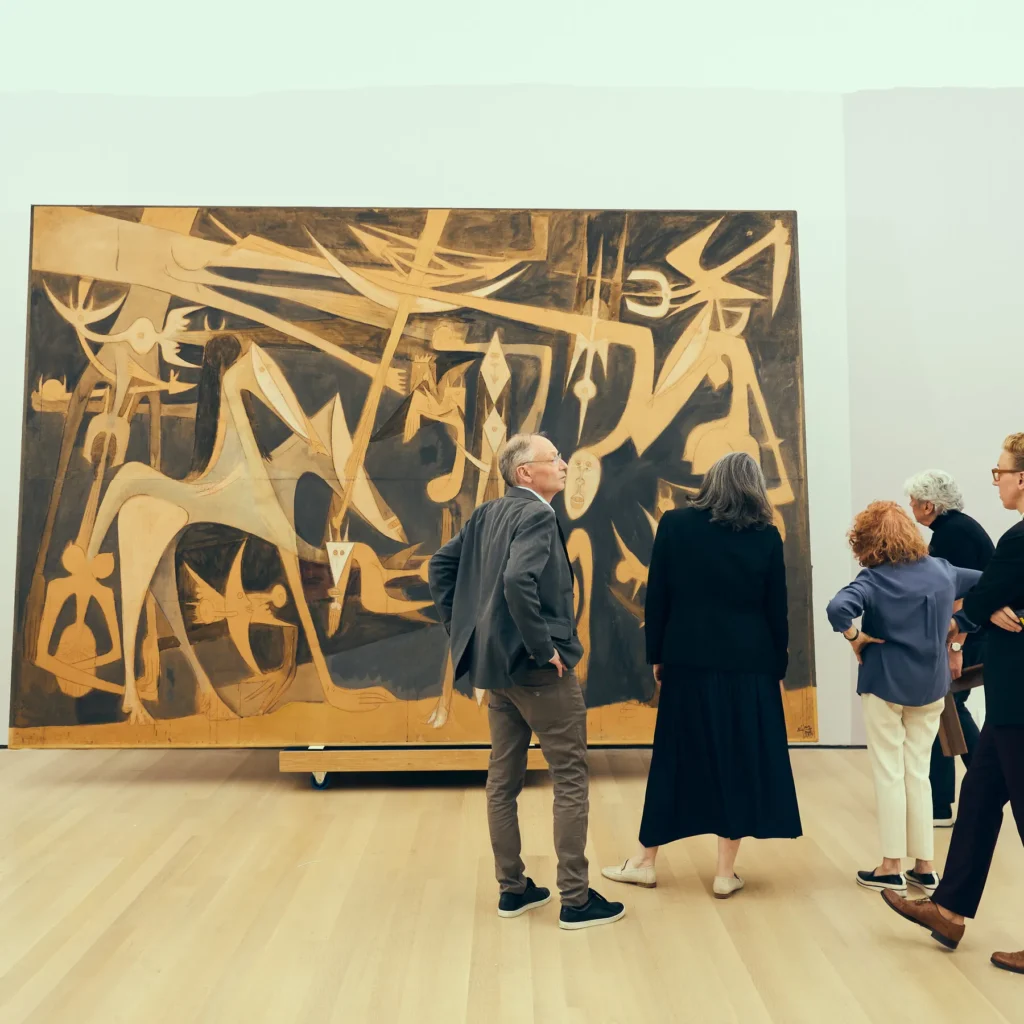
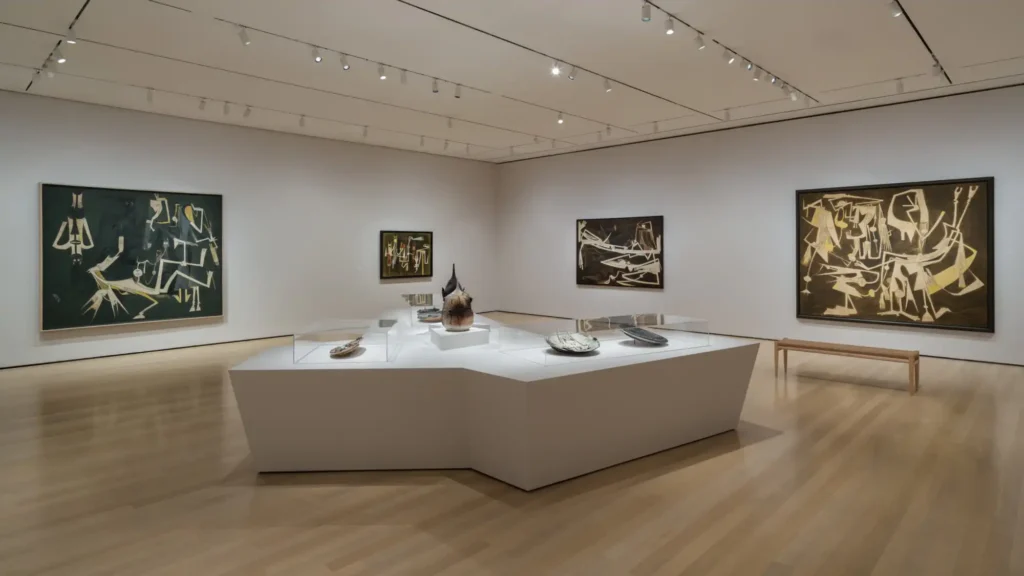
In November 2025, the Museum of Modern Art in New York opened Wifredo Lam: When I Don’t Sleep, I Dream, the first comprehensive retrospective devoted to the Cuban painter in the United States. The exhibition, on view through April 2026, has prompted a renewed wave of interest among American collectors in an artist whose place in the canon has long been secured in Paris, London and Havana, but who had never received this level of institutional attention on US soil.
Who was Wifredo Lam?
Wifredo Lam (1902–1982) was a Cuban modern artist of Afro-Cuban, Chinese and Spanish ancestry whose work fused the European avant-garde (cubism and surrealism) with the visual world of Afro-Caribbean spirituality, particularly Santería and the Yoruba pantheon. He is considered one of the most important Latin American painters of the twentieth century, and one of the few Caribbean artists to have entered the canon of international modernism on equal terms with his European contemporaries.
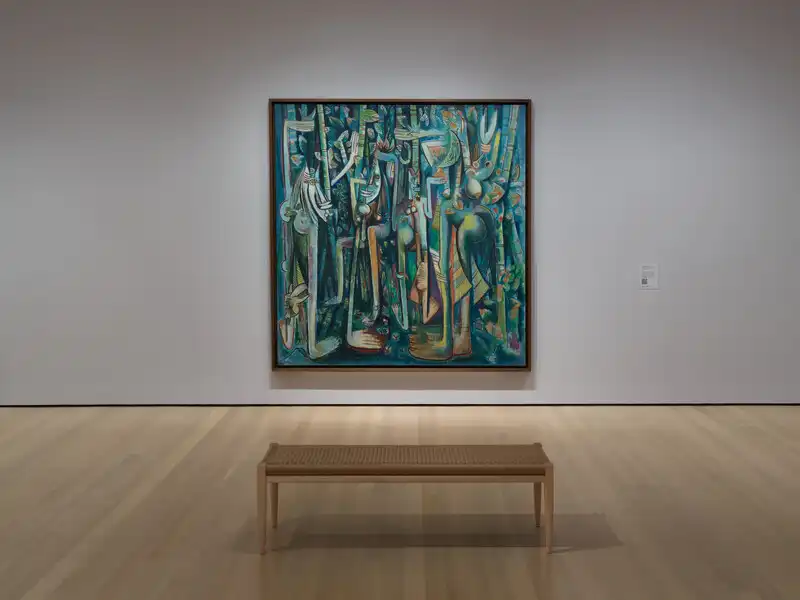
His most widely known work, The Jungle (1943), has belonged to the collection of the Museum of Modern Art in New York since 1945 and remains a touchstone for any discussion of modernism beyond Europe. Lam’s painting is held by the MoMA, the Tate Modern, the Centre Pompidou, the Metropolitan Museum of Art, the Reina Sofía in Madrid and the Musée Cantini in Marseille, among many other public institutions.
Where was Wifredo Lam born? A brief Wifredo Lam biography
Wifredo Lam was born on 8 December 1902 in Sagua la Grande, a small town in the sugar-producing province of Villa Clara in central Cuba. His father, Enrique Lam-Yam, was a Chinese immigrant from Canton (Guangdong); his mother, Ana Serafina Castilla, was the daughter of a formerly enslaved Congolese woman and a Cuban mulatto man. This triple heritage would later become the conceptual underpinning of his mature painting.
In 1916 the family moved to Havana, where Lam enrolled at the Academia de San Alejandro. In 1923, with a scholarship from the municipality of Sagua la Grande, he sailed for Spain. He spent fifteen years in Europe: in Madrid he studied with Fernando Álvarez de Sotomayor — then director of the Prado —. He fought on the Republican side in the Spanish Civil War (1936–1937), and in 1938 fled Barcelona for Paris with a letter of introduction to Pablo Picasso. There he met André Breton and joined the Surrealist circle. In 1941, escaping the Nazi occupation of France, he returned to Cuba after eighteen years abroad. He died in Paris on 11 September 1982.
What artistic movement did Wifredo Lam belong to?
Wifredo Lam is generally placed at the intersection of three movements: late cubism, surrealism and what the critic Alejo Carpentier called “lo real maravilloso” (the marvellous real that would later be associated with Latin American magical realism). In Paris between 1938 and 1941, Lam became an active member of the Surrealist group around André Breton. His work was reproduced in the movement’s journals, and Breton wrote the preface to his 1942 exhibition at the Pierre Matisse Gallery in New York.
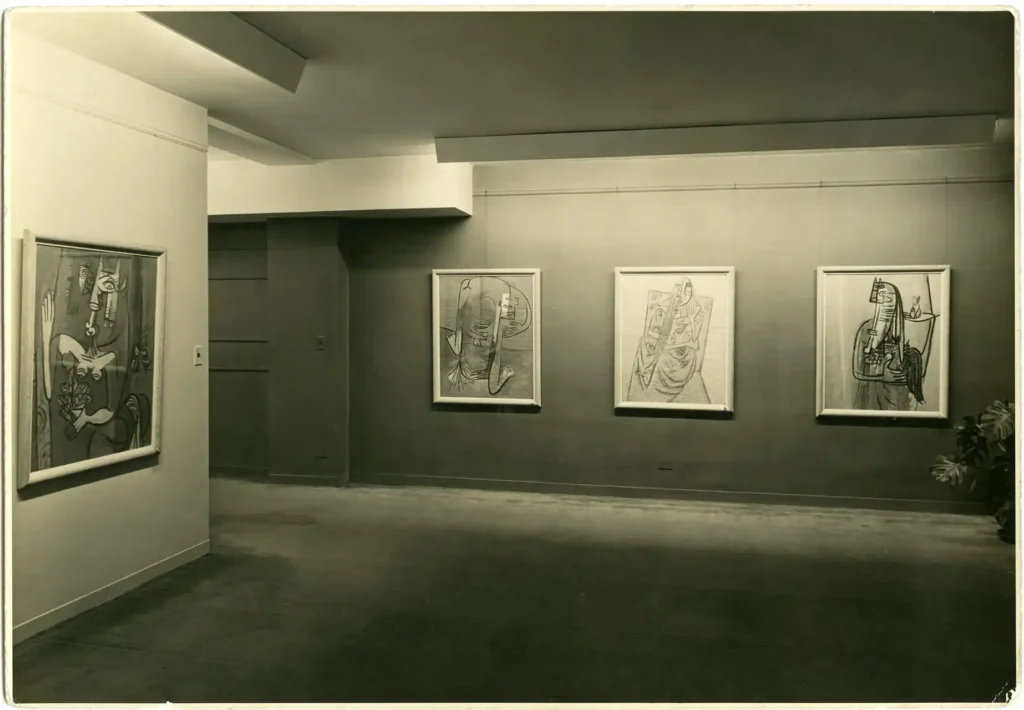
After his return to Cuba in 1941, however, his painting departed from European surrealism in a decisive way. The dream imagery of Breton’s circle gave way to a syntax built from Afro-Cuban ritual, the iconography of Santería, the dense vegetation of the Caribbean and the legacy of West African sculpture. Lam himself described his art as “an act of decolonisation”. The label “surrealist” remains accurate but insufficient: his real contribution is to have opened surrealism to a non-European cosmology without losing its formal rigour.
How did Picasso influence Wifredo Lam?
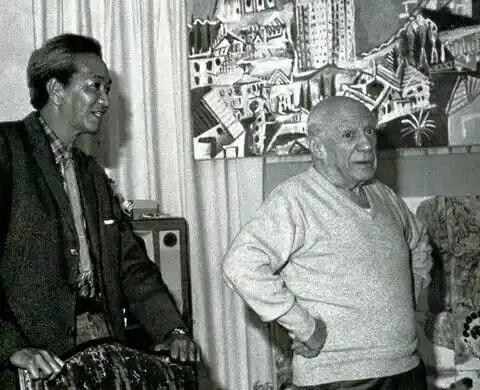
Picasso was, by Lam’s own account, the decisive figure of his Paris years. The two met in 1938. Picasso introduced him to his dealer Pierre Loeb — who organised Lam’s first Paris exhibition in 1939 — and brought him into a circle that included Joan Miró, Henri Matisse, Fernand Léger, Tristan Tzara, Paul Éluard and Georges Braque. They shared, beyond personal sympathy, a deep interest in African sculpture: Picasso had already integrated African forms into his work since Les Demoiselles d’Avignon, and he recognised in Lam an artist for whom that visual world was not exotic but biographical.
The influence, however, was never one-directional. Lam absorbed Picasso’s cubist syntax — the angular reorganisation of bodies, the rejection of single-point perspective — and used it to build a personal language in which African and Caribbean references were sources of meaning, not formal devices. Critics have called Lam “the Cuban Picasso”, but the formula is misleading: Lam took from Picasso what could be taken, and built from there the only modernism that could legitimately speak from the Caribbean.
What makes Wifredo Lam’s style unique?
Lam’s style is defined by hybrid figures — part human, part animal, part vegetal — that inhabit dense, dark backgrounds in which the boundary between body and forest dissolves. His most famous painting, The Jungle (1943), is the clearest statement of this language: four figures with horse-like heads emerge from a thicket of sugarcane, their limbs interlocking and shifting between species. Femme cheval, his recurring “horse-woman” motif, draws directly on Santería, where the practitioner becomes the “horse” ridden by the orisha during possession.
Three formal features make his work immediately recognisable. First, a chromatic palette restricted to deep greens, ochres, blacks and warm whites, far from the saturated colours often associated with Caribbean painting. Second, a relentless verticality: figures rise rather than rest, sustaining a tension between ascent and rootedness. Third, an absence of background depth: the composition is flat, frieze-like, as if everything happened on the same ritual plane. This combination is unique to Lam and has no real precedent in either European or Latin American modernism.
Why do collectors buy Wifredo Lam?
Collectors who acquire Wifredo Lam typically do so for three converging reasons. The first is art-historical: Lam is one of the few painters whose work belongs simultaneously to the canon of European modernism — through cubism and surrealism — and to the foundational chapter of Latin American and Afro-Caribbean modern art. Owning a Lam means owning a node where two histories meet.
The second reason is institutional. Lam is held by the MoMA, the Tate Modern, the Centre Pompidou and the Metropolitan Museum, among others; the 2025–2026 MoMA retrospective adds a new layer of contemporary visibility. For private collectors, this institutional density acts as a long-term anchor of value.
The third reason is structural. As the collector’s guide to art acquisition makes clear, works of this calibre can perform as long-horizon assets within a diversified holding strategy. Lam offers both critical density and market depth, in a segment — modern Caribbean and Afro-Cuban painting — that remains comparatively under-represented in many US collections.
Wifredo Lam at Duque Arango Gallery
Wifredo Lam is part of the secondary market programme at Duque Arango Gallery. We have presented works by Lam in our booths at different international art fairs such as Art Miami and Zona Maco, and we work with collectors on an individual basis to identify and acquire pieces that fit a specific collection profile. For a broader view of the Cuban modern context in which Lam belongs, we have also published essays on three Cuban artists we represent and on four Cuban artists you should know. To access the current selection of works by Wifredo Lam, please request to be contacted by our private advisory team.