Oscar Murillo, artist: who he is and why his work matters now
Oscar Murillo (born 1986, La Paila, Valle del Cauca, Colombia) is one of the most internationally recognised contemporary artists working today. His practice is multidisciplinary by design: painting, conceptual art, installation art, performance and long-term collaborative projects share equal weight in his production. The work investigates migration, labour, displacement and globalisation — questions framed by his own biography and developed at museum scale.
In December 2019, Murillo received the Turner Prize 2019 jointly with Lawrence Abu Hamdan, Helen Cammock and Tai Shani. The four shortlisted artists asked the jury to award the prize collectively, in the name of “commonality, multiplicity and solidarity”. The decision was the first of its kind in the history of the Turner Prize and is now part of the institutional reading of Murillo’s practice.
Oscar Murillo biography
Murillo was born in La Paila, a small town in the sugarcane region of Valle del Cauca, in 1986. He moved with his family to London at the age of ten. He trained at the University of Westminster and then completed his MFA at the Royal College of Art in 2012 — the year his work entered the international gallery circuit, with representation by Carlos/Ishikawa in London and the David Zwirner gallery taking him on globally the year after.
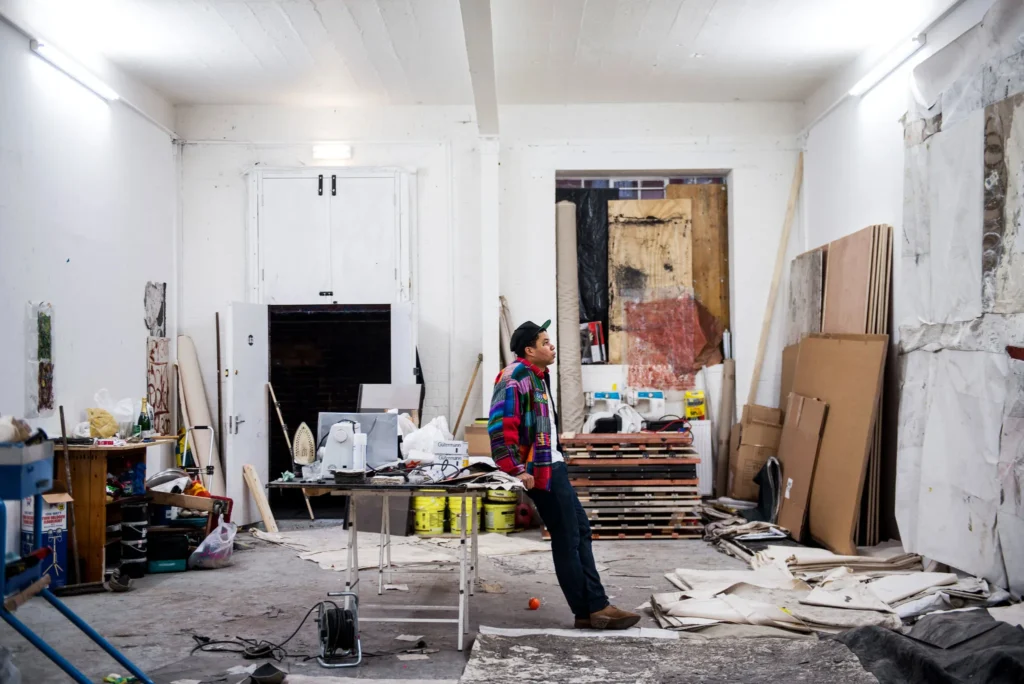
His early career trajectory was rapid even by the standards of contemporary art in the 2010s. By 2014, his work had been included in landmark presentations at the Serpentine Gallery, Kettle’s Yard in Cambridge, the Hammer Museum in Los Angeles and major art fairs from Frieze to Art Basel. The Princeton University Art Museum staged a solo exhibition. Through the rest of the decade he developed a practice that moves between studio painting, room-scale installation and projects in schools across more than thirty countries. He maintains studios in London and the United Kingdom and continues to work between Europe, Latin America and Asia.
Oscar Murillo paintings: surface, scribble and the accumulation of time
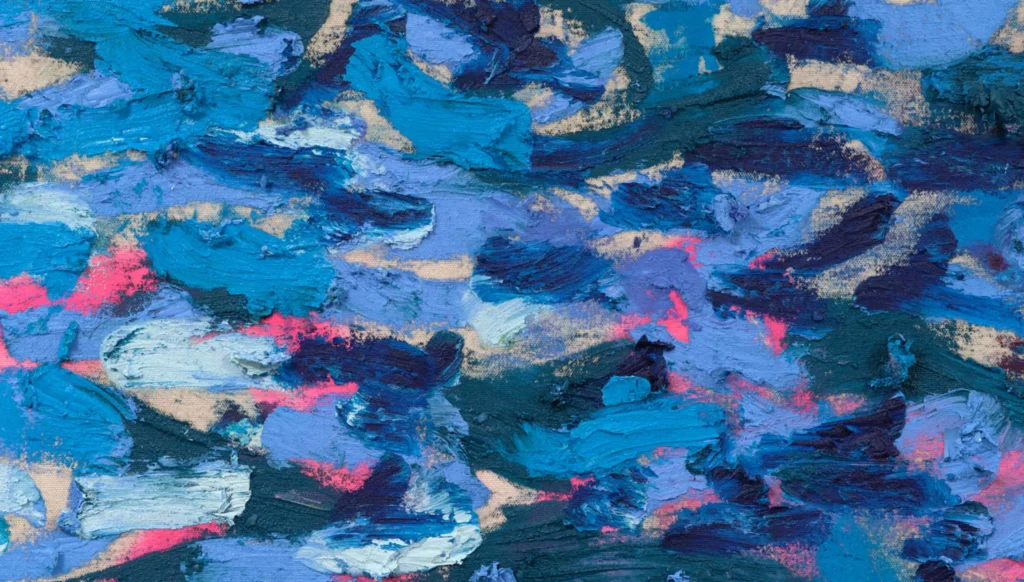
Oscar Murillo paintings are best understood as records of duration. The canvases are produced through a layered process: gestural marks, looped lines, scribbles and fragments of text are applied over extended periods, and the surfaces are then left in the studio to accumulate dust, debris and traces of use. The unstretched canvases are folded, dragged across floors, stacked. By the time they reach a gallery wall, each painting is a topography of its own making, somewhere between automatic drawing and material residue.
This way of working positions Murillo within the most ambitious lineage of contemporary painting today. The reference points are clear — abstract expressionism reframed through the language of debris, the conceptual decisions of process-based painters of the 1960s and 1970s — but the result is unmistakably his own. The painting is never only the painted surface; it is also what has happened to that surface over time. In the secondary market, these works are routinely described as Oscar Murillo artwork rather than as discrete paintings, precisely because they exceed the conventional boundary between object and process.
Oscar Murillo art and conceptual practice: text, residue and labour
Conceptual art is the framework that holds the rest of Murillo’s production together. His paintings, sculptures, sound pieces and large-scale installations all proceed from the same set of underlying questions: how does global labour leave a visible trace? How does displacement become material? How does language inhabit objects? Words and phrases — sometimes scrawled across canvases, sometimes printed on industrial fabric — circulate through the work as fragments of biography and politics rather than as decoration.
The Oscar Murillo art that has had the strongest critical reception is the work that treats material itself as conceptual statement. Soiled canvases, recycled industrial textiles, found objects from sugarcane production, recordings of factory floors and migrant routes: each operates as evidence within a broader argument about contemporary art as a witness to global circulation. The reading is now sufficiently consolidated for museum exhibitions to treat it as a given rather than as a thesis to be defended.
Installation art and contemporary installation: Frequencies, The Flooded Garden, the black flags
Installation art is where Murillo’s ambitions show most clearly. Three projects, in particular, define his contribution to contemporary installation and have shaped his international standing.
Frequencies is the longest-running. Initiated in 2013, the project temporarily affixes blank canvases to classroom desks in schools around the world; students aged ten to sixteen draw, write and doodle on them over the course of the school year. The accumulated canvases — to date, contributions from more than three hundred schools across more than thirty countries — form a global archive of adolescent mark-making. Frequencies has been presented at the Haus der Kunst in Munich (2017), the Museum of Contemporary Art in Cleveland (2017), the Yorkshire Sculpture Park (2019), the Swiss Institute in New York (2021), the Mori Art Museum in Tokyo (2021), TANK Shanghai (2021) and the Javett Art Centre in Pretoria (2023).
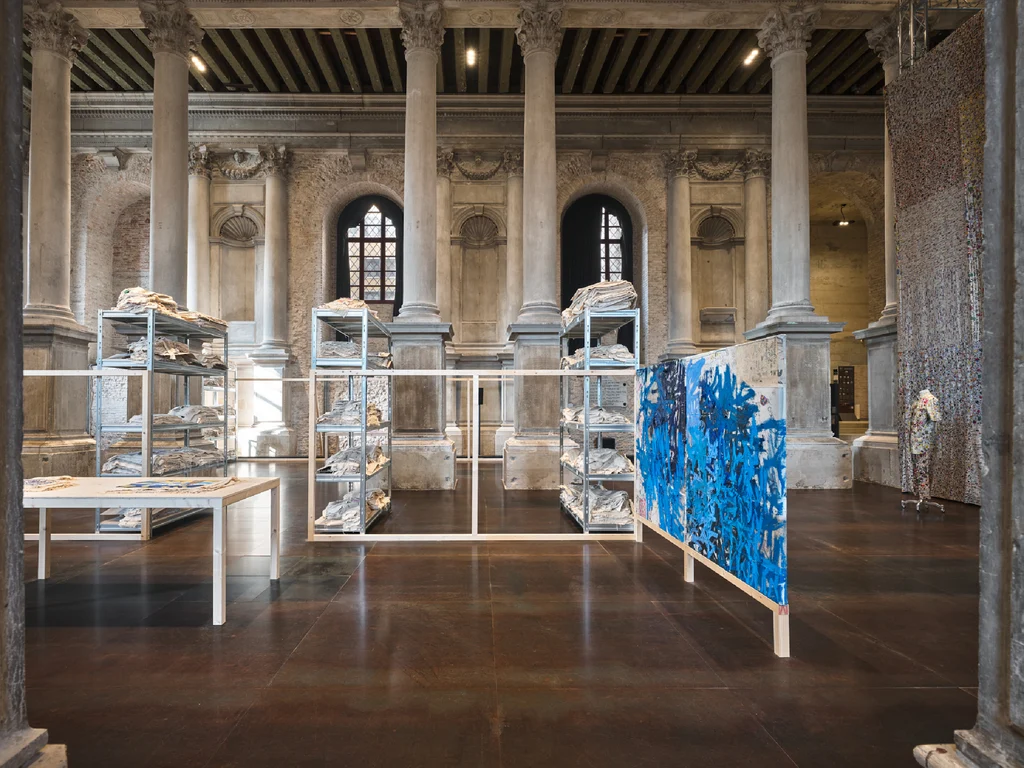
The Flooded Garden, presented in the Turbine Hall of the Tate Modern from July to August 2024, was a participatory installation that invited visitors to paint together on a vast horizontal canvas. For two months, the Turbine Hall — one of the most visited spaces in contemporary art — was open to direct mark-making by the public. The work pushed Murillo’s logic of collaborative production to one of its most visible expressions.
The black flags, installed on the facade of the international pavilion at the Venice Biennale, function as a counterpoint: twenty-six monumental flags in black canvas, produced in his studio with the participation of his family, present a silent and stripped-down image of representation. Together, Frequencies, The Flooded Garden and the black flags define a model of contemporary installation in which scale, participation and political reading are inseparable.
Oscar Murillo at Duque Arango Gallery
Duque Arango Gallery includes Oscar Murillo within its programme of Latin American contemporary art and presents his work to collectors through a private advisory process. For a broader view of the artists in this segment, our editorial dossier on contemporary Latin American artists you must know offers context. To access the current selection of Oscar Murillo artwork available through the gallery, please request to be contacted by our private advisory team.
To explore Oscar Murillo paintings and works available through Duque Arango Gallery, please request to be contacted by our private advisory team. Each work is presented individually, with full provenance documentation.