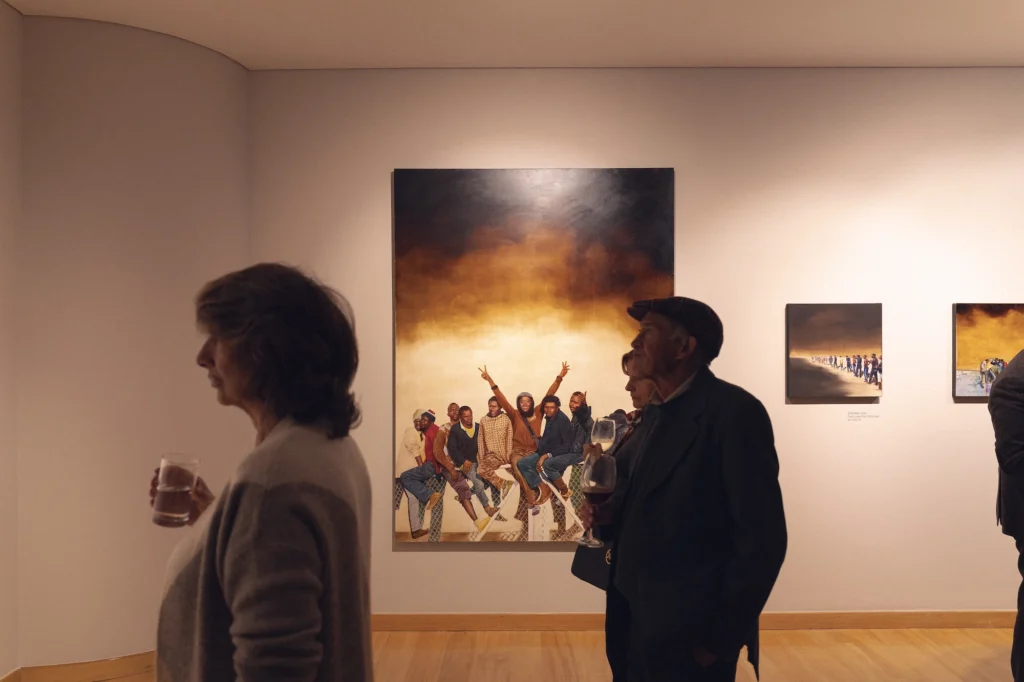
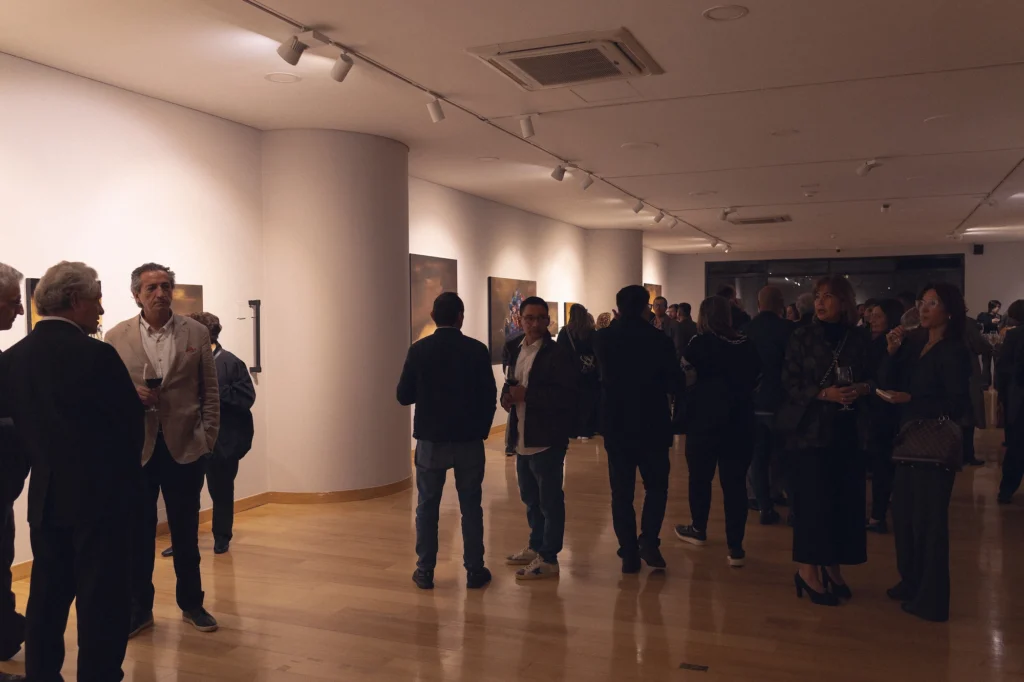
Bogota’s cultural scene continues to expand with exhibitions that reflect the depth and complexity of contemporary Latin American art. Among the most significant current presentations is the exhibition of the series Éxodos by Sair Garcia, currently on view at Club El Nogal, one of the most influential social and cultural institutions in the Colombian capital. Open until March 25, the exhibition offers an opportunity to encounter one of the most powerful bodies of work produced by the artist in recent years.
Within the context of Bogotá’s private cultural institutions, the presentation of Éxodos holds particular relevance. Social clubs have increasingly assumed a role not only as gathering spaces but also as platforms for artistic dialogue. In this setting, the exhibition introduces political contemporary art to an audience that includes collectors, cultural leaders, and professionals deeply engaged with the city’s intellectual life.
From Duque Arango Galería, we celebrate this moment in the trajectory of Sair Garcia artist, whose work continues to gain recognition among contemporary art collectors and within the broader Latin American art market.
Who is Sair Garcia? Trajectory and relevance in contemporary Colombian art
To understand the importance of the exhibition at Club El Nogal, it is necessary to consider the trajectory of Sair Garcia, one of the most consistent voices within contemporary art in Colombia.
Garcia has developed a practice that moves between painting, drawing, and installation, but it is through figurative contemporary painting that his visual language has reached its most compelling form. His work is grounded in a profound exploration of historical memory, social conflict, and the human consequences of political violence. Through a rigorous technical approach, Garcia constructs images that combine emotional intensity with formal discipline.
The artist’s compositions often depict groups of figures suspended in ambiguous landscapes or transitional spaces. Bodies appear fragmented, layered, or enveloped in atmospheric environments created through careful veladuras, chromatic superpositions, and controlled contrasts of light and shadow. This technical precision allows the artist to build scenes that oscillate between realism and metaphor.
Garcia’s work stands out within the field of visual storytelling in contemporary art. Rather than narrating events in a literal manner, his paintings evoke emotional and historical realities through symbolic imagery. The result is a body of work that invites reflection rather than offering simple illustration.
Over the years, the work of Sair Garcia artist has been presented in galleries, institutional exhibitions, and significant cultural platforms both in Colombia and abroad. His practice is distinguished by thematic coherence and conceptual depth, positioning him as an important figure among emerging Latin American artists whose work addresses urgent social realities through sophisticated visual language.
Sair García artworks: Éxodos: memory, displacement, and territory
The series Éxodos represents one of the central pillars of Garcia’s artistic research. Through this body of work, the artist addresses the phenomenon of forced displacement and internal migration. In these paintings, Garcia explores art about displacement and art about migration from a perspective that transcends documentary representation. Rather than illustrating specific events, he constructs visual environments that evoke the emotional and psychological dimensions of exile, loss, and survival.
The figures that inhabit Éxodos are often portrayed in motion. Groups of individuals move across undefined landscapes carrying minimal belongings or symbolic objects that suggest fragments of personal history. These gestures transform the paintings into meditations on human displacement, where the act of moving becomes both a physical necessity and a metaphor for cultural rupture.
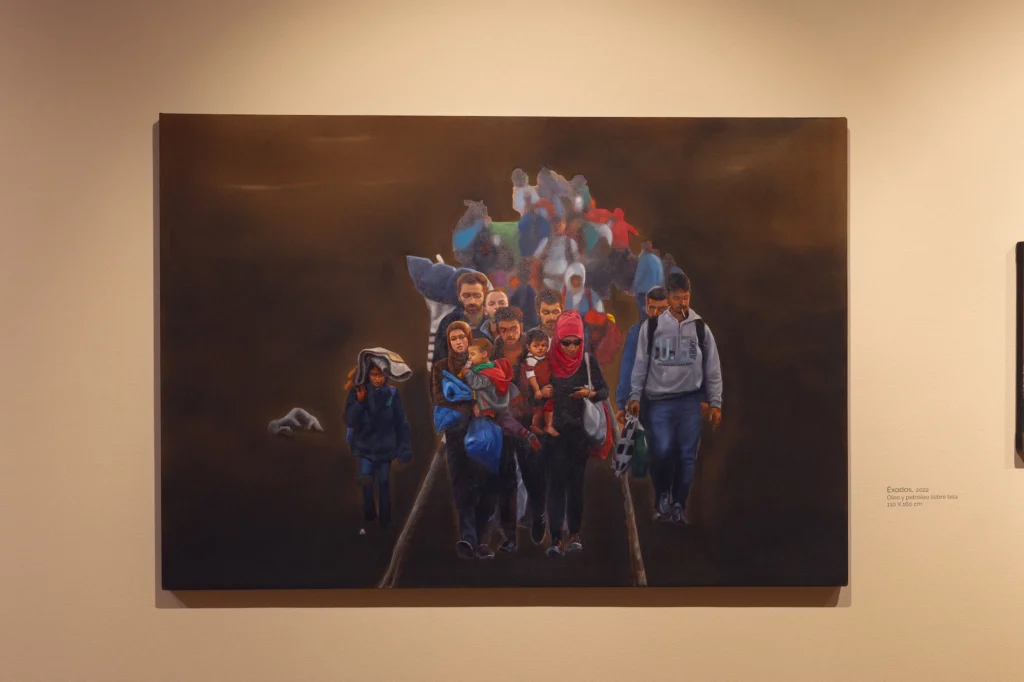
Garcia’s compositions emphasize the vulnerability of the human body while simultaneously conveying resilience. Faces are sometimes partially obscured, bodies overlap, and spatial perspectives shift, creating a sense of instability that mirrors the uncertainty experienced by displaced populations.
At the conceptual core of Éxodos lies the relationship between art and memory. The works function as visual archives that preserve traces of collective trauma while acknowledging the persistence of human dignity. In this sense, Garcia’s paintings operate within the broader tradition of political contemporary art, where aesthetics and social reflection intersect.
Although deeply rooted in Colombia’s historical context, the themes addressed in the series resonate globally. Migration crises, forced displacement, and the reconfiguration of territories are phenomena that shape societies across continents. Through this perspective, Éxodos enters into dialogue with international discussions about identity, borders, and belonging.
Sair Garcia at Club El Nogal: contemporary art in an emblematic cultural space
The presentation of Éxodos at Club El Nogal highlights the evolving role of private cultural institutions in Bogotá’s artistic ecosystem. Traditionally recognized as one of the city’s most prestigious social clubs, El Nogal has increasingly integrated cultural programming that connects its members with significant artistic practices.
Hosting an exhibition by Sair Garcia reinforces the club’s commitment to presenting intellectually engaging artistic content. The artist’s work is not merely decorative; it demands careful attention and contextual understanding. The presence of this exhibition within such a setting encourages conversations that extend beyond aesthetic appreciation into broader cultural and historical reflection.
For contemporary art collectors, the exhibition also represents an opportunity to engage directly with the work of an artist whose practice continues to gain momentum within the Latin American art market. The growing international interest in Latin American art has brought renewed attention to artists who address regional histories through globally resonant themes.
In this context, the exhibition at Club El Nogal functions as both a cultural event and a platform for expanding the visibility of contemporary art in Colombia among influential audiences.
The exhibition remains open until March 25, allowing visitors to experience firsthand a body of work that articulates some of the most pressing questions surrounding identity, territory, and collective memory.
Duque Arango Galería and the projection of Sair Garcia
Duque Arango Galería has played a significant role in supporting and promoting the career of Sair Garcia artist, recognizing early on the strength and coherence of his artistic vision. The gallery’s commitment to artists whose work combines conceptual rigor with technical excellence aligns closely with Garcia’s practice.
Within the gallery’s program, Garcia is a Colombian artist represented by Duque Arango Galería who occupies an important position among artists whose work contributes to shaping the discourse of contemporary Latin American art. His paintings are increasingly present in private collections and are gaining recognition among collectors seeking works that possess both aesthetic depth and historical significance.
This depth of investigation gives the work a lasting resonance that extends beyond national boundaries, situating Garcia within a broader network of emerging Latin American artists whose practices explore issues of displacement, identity, and historical memory.
Bogota as a strategic center for contemporary art
The exhibition of Éxodos also reflects the broader cultural dynamism of Bogotá. Over the past two decades, the city has consolidated itself as one of the most important centers for contemporary art in Colombia and an increasingly visible player within the international Latin American art market.
A network of galleries, museums, art fairs, and independent institutions contributes to this ecosystem. Events such as ARTBO and the growth of institutional programming across the city have helped position Bogotá as a destination for collectors, curators, and cultural professionals.
Within this landscape, spaces like Club El Nogal demonstrate how cultural initiatives can extend beyond traditional museum contexts. By integrating exhibitions into social environments, these institutions contribute to expanding the circulation of artistic ideas and reaching audiences that might not otherwise encounter contemporary art.
The presence of Sair Garcia within this context reinforces the idea that Bogotá’s artistic vitality lies not only in its formal institutions but also in the diversity of platforms that support artistic production and dialogue.
The exhibition of Éxodos offers a profound exploration of themes that continue to shape contemporary societies: migration, memory, and the transformation of territories.
Through the powerful language of figurative contemporary painting, Sair Garcia constructs images that challenge viewers to confront the realities of human displacement while recognizing the resilience embedded within these narratives. His work exemplifies how visual storytelling can transform historical trauma into a space for reflection and critical engagement.